
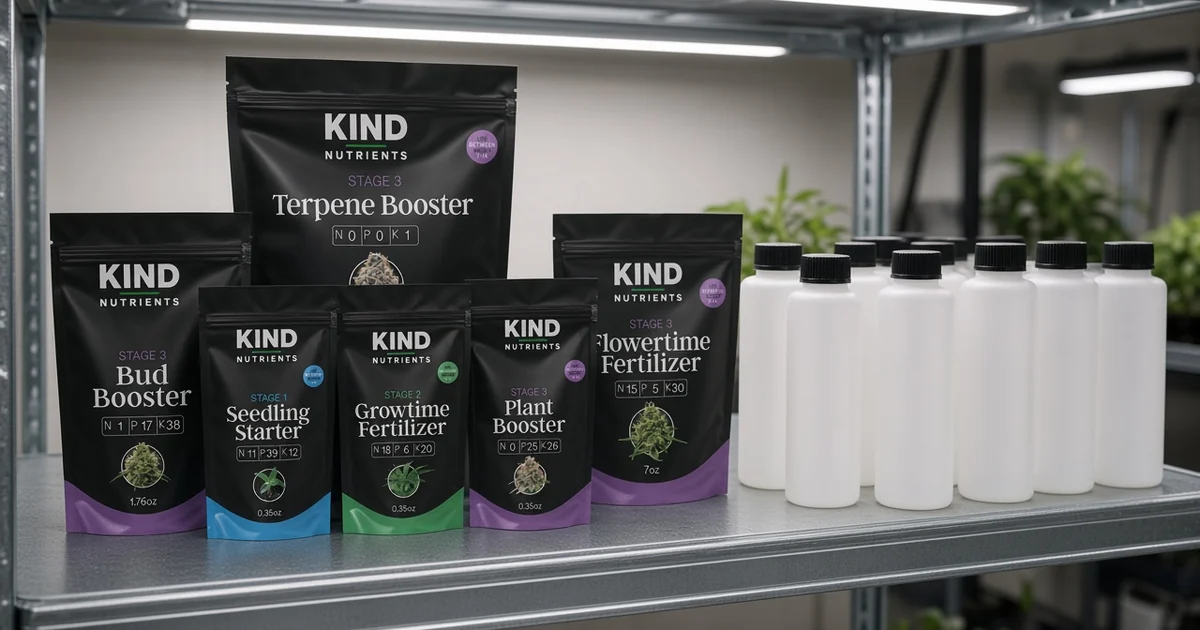
When you compare powder vs liquid cannabis nutrients, the plant doesn’t really care which one you pick: once either is dissolved in water, roots take up the same mineral ions. The real differences are on your side of the bucket, in how you measure, how you store the product, what it costs to ship, and how many bottles or bags you need to keep track of.
Those trade-offs decide which format fits how you grow. The dry, water-soluble Kind Nutrients 6 Pack is the powder example here, since its numbers are published and easy to check.
What Powder vs Liquid Cannabis Nutrients Have in Common
Both formats deliver nitrogen, phosphorus, potassium, and secondary and micronutrients. The NPK numbers on any label tell you the percentage by weight of each major nutrient. A water soluble cannabis fertilizer like Flowertime (15-5-30) is concentrated because it’s dry, while a liquid version of a similar feed carries most of its weight as water.
Neither format is magic. Plant response depends on dose, pH, water quality, and your medium far more than on whether the product arrived as a powder or a liquid. A hydroponic trial published in PMC (PMC11882401) found that doubling EC from 2 to 4 mS/cm just built up salts without improving yield or flower quality. That lesson applies to both formats: feeding the right amount beats feeding more.
Dry vs Liquid Cannabis Nutrients: Quick Comparison
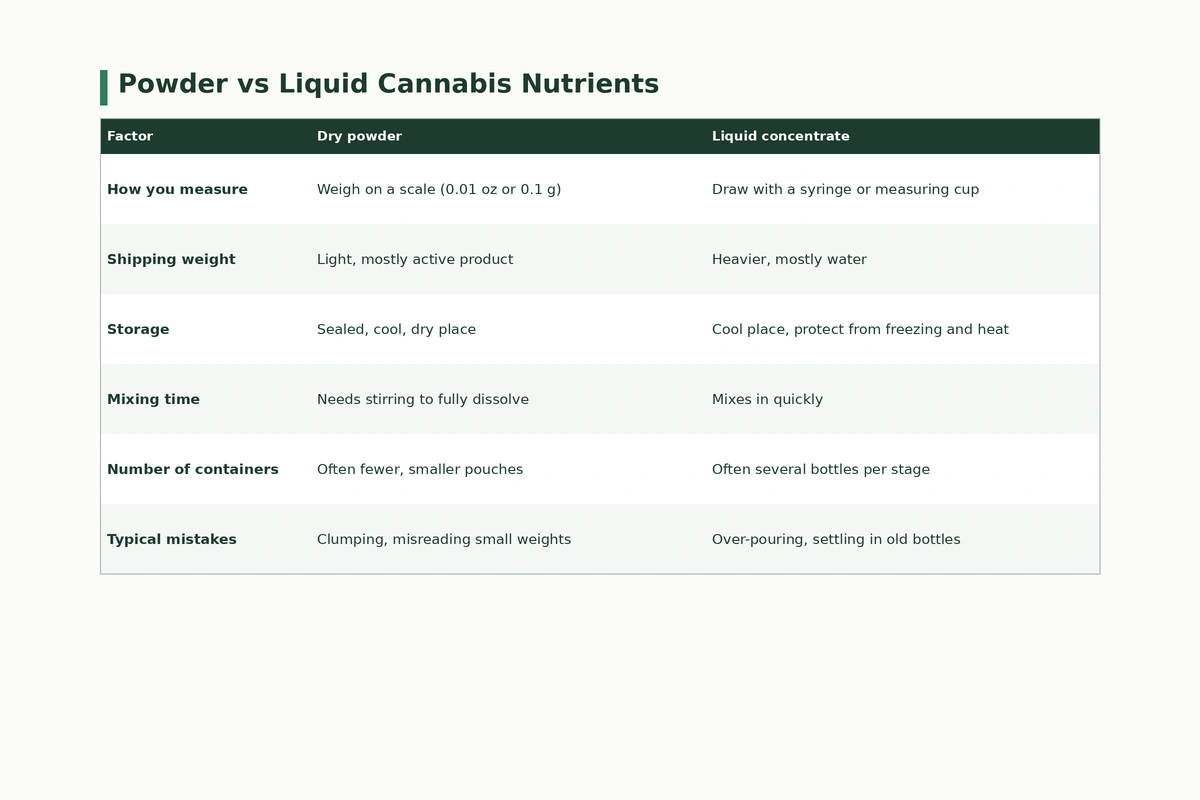
| Factor | Dry powder | Liquid concentrate |
|---|---|---|
| How you measure | Weigh on a scale (0.01 oz or 0.1 g) | Draw with a syringe or measuring cup |
| Shipping weight | Light, mostly active product | Heavier, mostly water |
| Storage | Sealed, cool, dry place | Cool place, protect from freezing and heat |
| Mixing time | Needs stirring to fully dissolve | Mixes in quickly |
| Number of containers | Often fewer, smaller pouches | Often several bottles per stage |
| Typical mistakes | Clumping, misreading small weights | Over-pouring, settling in old bottles |
Dosing Accuracy: Scale vs Syringe
Liquids feel easier at first because you can pour them. The catch is that a heavy pour adds up fast, and many liquid lines stack several bottles per watering. Syringes fix most of that, which is why they’re a good habit even for liquid growers.
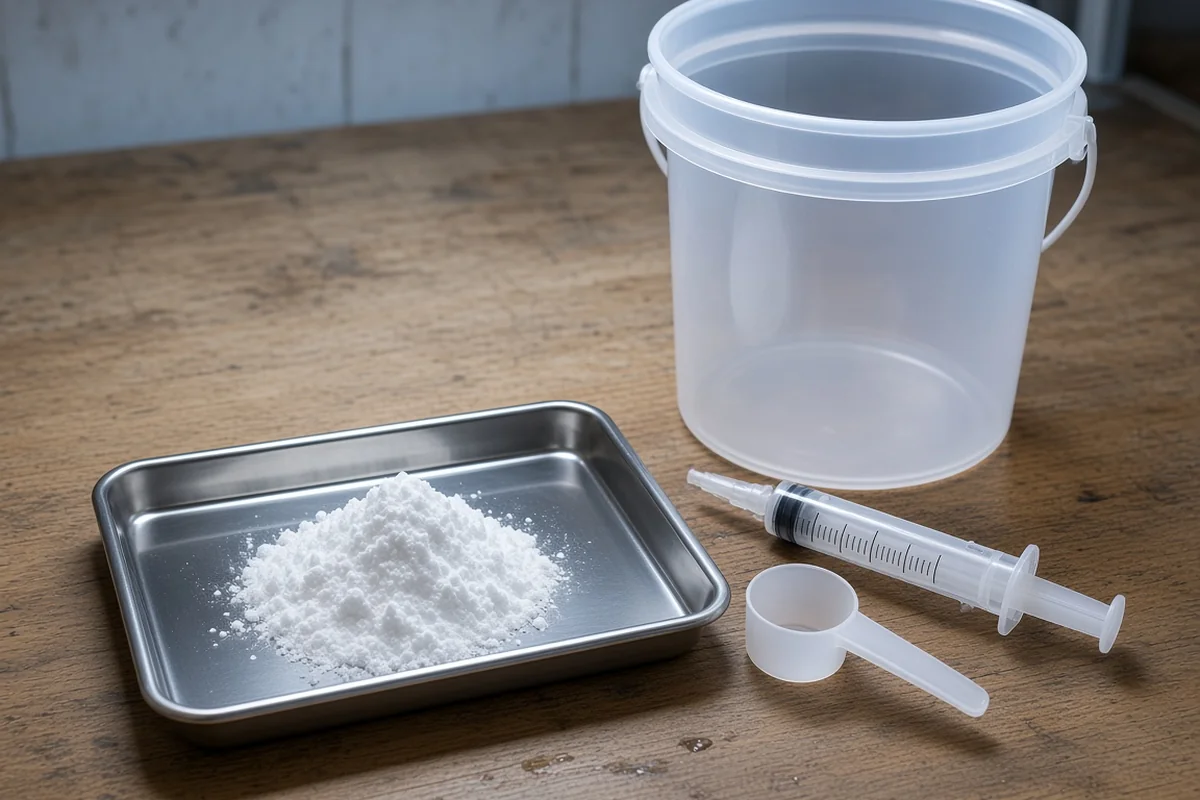
Powders ask you to weigh. That sounds fussy until you’ve done it twice. Kind Nutrients’ doses are small (0.14 oz of Seedling Starter in 2 gallons, 0.21 oz of Growtime in 2 gallons, 0.85 oz of Flowertime in 6 gallons), so the site recommends a scale that reads to 0.01 oz. A kitchen scoop simply isn’t accurate at that size.
The Nutrient Dosing Kit ($37) covers both formats. It includes a 0.1 g pocket scale for powders, 10, 30, and 60 ml syringes for liquids, and two metric measuring cups. If you ever mix a liquid additive with a dry base, you’ll have the right tool for each.
Storage and Shelf Life of Powder vs Liquid Cannabis Nutrients
Dry nutrients are easy to store. Keep pouches sealed, away from humidity, and out of direct sun. Moisture is the enemy, since damp powder can cake into hard lumps that are harder to weigh and dissolve.
Liquids need a stable temperature. Bottles left in a hot garage or a freezing shed can separate or settle, and some growers find they need to shake old bottles hard before every use. Liquids also take up more shelf space, which matters if you grow in a closet or small tent.
Cost and Shipping: Picking the Best Cannabis Nutrient Kit
Shipping water costs money. Because liquids are mostly water, the box weighs more and the price you pay often reflects that. Dry pouches are light, which helps keep shipping cheap or free.
For a concrete powder example, Kind Nutrients sells six single pouches that add up to $156: Seedling Starter $17, Growtime $21, Flowertime $40, Bud Booster $26, Plant Booster $17, and Terpene Booster $35. The 6 Pack bundles all six for $138, and US orders ship free within 3 business days to all 50 states. The product pages describe each pouch as feeding at least 6 plants through its stage on the published chart (Terpene Booster says up to six).
When you price any kit, look past the sticker. Ask how many plants it covers, how many weeks of the schedule it supplies, and whether you’ll need extra bottles to finish a run. You can browse every pouch and supply on the Kind Nutrients shop page.
How to Switch From Liquid to Powder Nutrients Step by Step
- Finish or set aside your current liquid run. Don’t mix two full programs in the same watering.
- Get a scale that reads to 0.01 oz (0.1 g works too). Zero it with your empty container on it.
- Read the chart for the week you’re in. With the 14-week chart, seedling and veg doses go in 2 gallons and flower doses go in 6 gallons.
- Fill your bucket with the full water volume first, then add the powder.
- Stir until the water looks clear and no grains sit on the bottom. Add one product at a time.
- Check pH: 6.0 to 7.0 in soil (about 6 is a good target) and 5.5 to 6.5 in hydro.
- If you grow in hydro, check EC too, and start conservatively.
- Watch the plants for three to five days before changing anything.
For a deeper walkthrough, see our guide on how to mix dry cannabis nutrients and the full cannabis feeding schedule.
Which Format Fits Your Grow?
Powder tends to suit growers who like simple shelves, small pouches, low shipping weight, and a single printed chart. It also suits people who don’t mind owning a small scale.
Liquid tends to suit growers who already own syringes, like the speed of pouring, and run large reservoirs where small weighing errors would be harder to manage by hand.
Neither one fixes bad pH, cold roots, or overfeeding. If your plants struggle, start with the basics and measure. Our EC and PPM guide shows how to check feed strength and runoff so you know what’s really in the root zone.
Troubleshooting
Powder won’t fully dissolve. You probably added it to a small amount of water or dumped several products in at once. Fill the full volume first, add one product at a time, and stir longer. Room-temperature water dissolves powder more easily than very cold water.
Burnt tips after switching formats. Growers sometimes keep pouring liquid by habit while also adding powder. Pick one program and stick to its chart.
Scale reads zero on tiny doses. Some kitchen scales don’t register small weights reliably. Place the container on first, tare, then add powder slowly. A pocket scale that reads to 0.1 g is more reliable.
Pouch caked into a lump. Moisture got in. Break it up gently in a dry container before weighing and store pouches sealed from now on.
pH swings after mixing. Different formulas move pH differently. Always measure after mixing, not before. A pH + TDS Meter Kit ($41) gives you a pH pen and a TDS/EC pen with calibration packets.
FAQ
Are powder nutrients stronger than liquid nutrients?
They’re more concentrated by weight because there’s no water in the package, but that doesn’t make them stronger in the bucket. Once you dissolve the right dose in the right volume, the solution strength depends on the recipe, not the format. That’s why powder doses look so small. A 0.21 oz dose of Growtime in 2 gallons can match what a much larger pour of a liquid would deliver. Always follow the chart for the product you’re using.
Is water soluble cannabis fertilizer good for hydro?
Yes, as long as it fully dissolves. Fully water-soluble powders are designed for that, and Kind Nutrients’ product pages describe their pouches as suitable for soil and hydro. In a reservoir, stir until the water is clear, then check pH (5.5 to 6.5) and EC. Undissolved grains can sit at the bottom and give you a false low EC reading, so mix thoroughly before you test and before you fill the system.
How long do dry nutrients last?
Kept sealed in a cool, dry place, dry nutrients stay usable for a long time because there’s little water inside to support change. The biggest risk is humidity, which makes powder clump. If you grow in a damp space, store pouches somewhere drier, like a closet outside the tent. Liquids, by contrast, are more sensitive to heat and freezing, and they can settle in the bottle if they sit for months.
Do I need special equipment for powder nutrients?
You need a scale, a bucket, and something to stir with. Kind Nutrients’ pages say no special gear is needed beyond a kitchen scale that reads to 0.01 oz. Many growers also add a pH pen because pH drives nutrient uptake. If you’d rather buy it all at once, the Nutrient Dosing Kit ($37) covers weighing and measuring, and the pH + TDS Meter Kit ($41) covers testing.
Can I mix powder and liquid nutrients together?
You can, but keep it simple. Running two full base feeds at once is an easy way to overfeed. If you use a liquid additive alongside a dry base, add each to the full water volume one at a time, stir between additions, and check pH and EC at the end. Start at reduced strength for the first watering and watch the leaves for a few days before you commit to the combo.
Leave a Reply