
A good cannabis feeding schedule gives each stage of the plant the nutrients it needs and nothing extra: a phosphorus-forward starter for two weeks, a nitrogen-rich grow feed for four weeks of veg, then eight weeks of potassium-heavy bloom feed with boosters on set weeks. If you follow that shape, measure doses on a scale, and keep pH in range, you’ll sidestep many of the burn and lockout problems that stall first grows.
The full 14-week plan ships with the Kind Nutrients 6 Pack. Each stage has a reason it looks the way it does, and the last two weeks before harvest work a little differently.
How a 14-Week Cannabis Feeding Schedule Is Built
The program splits a grow into three stages. Stage 1 is the seedling phase, grow weeks 1 and 2. Stage 2 is vegetative growth, grow weeks 3 through 6. Stage 3 is flowering, grow weeks 7 through 14, which the chart also labels flower weeks 1 through 8.
Water volume changes with the stage. Seedling and veg doses are mixed into 2 gallons of water, while flowering doses go into 6 gallons. Bloom doses are written for that larger batch, so don’t mix one into 2 gallons by mistake.
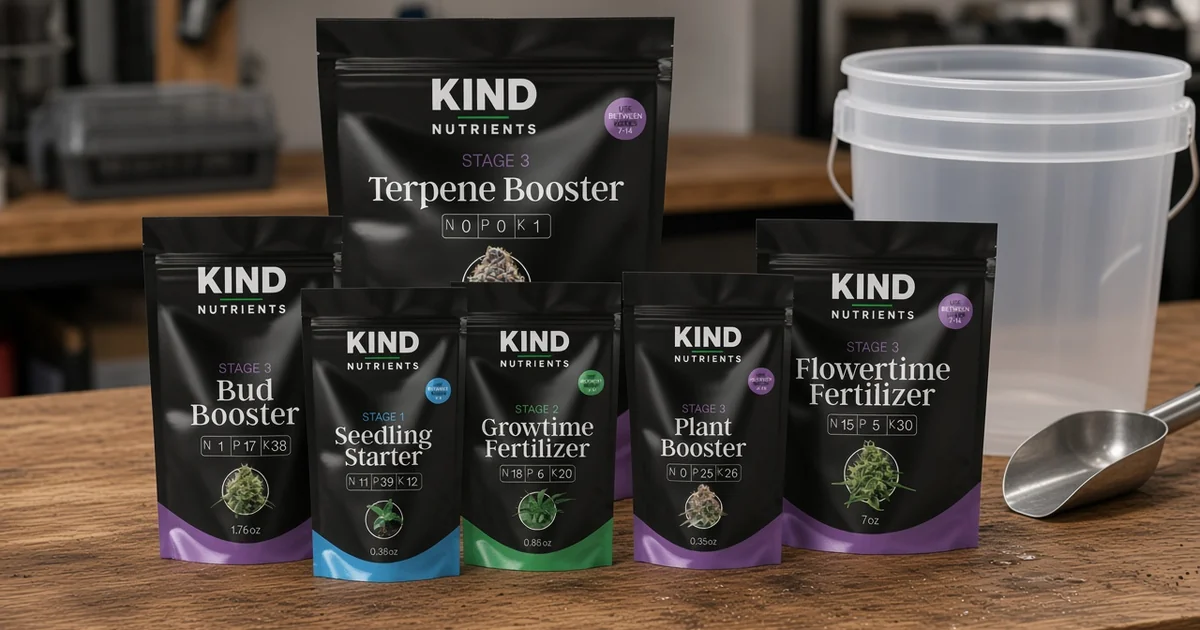
Each product has one job. Seedling Starter (11-39-12, $17, 0.35 oz) supports early roots. Growtime (18-6-20, $21, 0.88 oz) drives leafy veg growth. Flowertime (15-5-30, $40, 7 oz) is the base bloom feed. Bud Booster (1-17-38, $26, 1.76 oz), Plant Booster (0-25-26, $17, 0.35 oz), and Terpene Booster (0-0-1, $35, 5.3 oz) layer on top during flower.
Bought separately, the six pouches total $156. The 6 Pack bundles all of them for $138, and US orders ship free within 3 business days.
The Week by Week Cannabis Nutrient Chart
The table below puts the published grid on one 14-week calendar so you can’t misread which column belongs to which stage. Doses are per watering, mixed into the water amount shown.
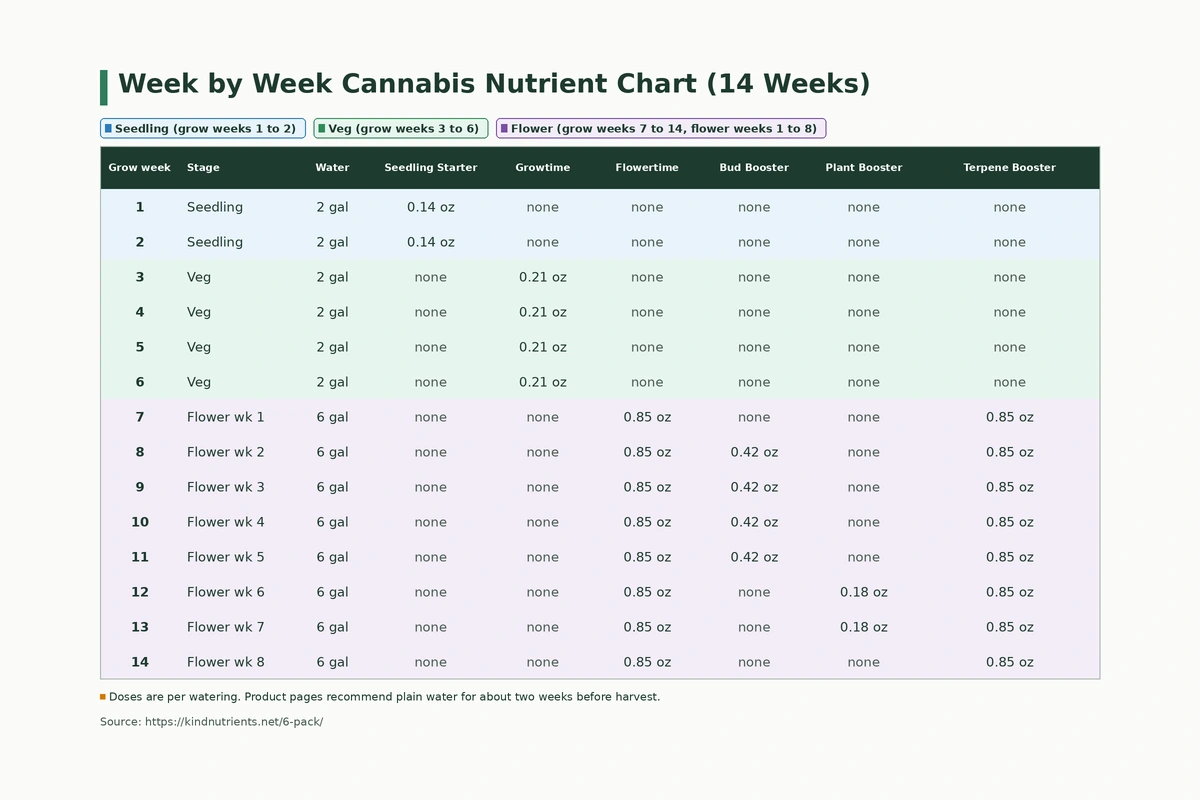
| Grow week | Stage | Water | Seedling Starter | Growtime | Flowertime | Bud Booster | Plant Booster | Terpene Booster |
|---|---|---|---|---|---|---|---|---|
| 1 | Seedling | 2 gal | 0.14 oz | none | none | none | none | none |
| 2 | Seedling | 2 gal | 0.14 oz | none | none | none | none | none |
| 3 | Veg | 2 gal | none | 0.21 oz | none | none | none | none |
| 4 | Veg | 2 gal | none | 0.21 oz | none | none | none | none |
| 5 | Veg | 2 gal | none | 0.21 oz | none | none | none | none |
| 6 | Veg | 2 gal | none | 0.21 oz | none | none | none | none |
| 7 | Flower wk 1 | 6 gal | none | none | 0.85 oz | none | none | 0.85 oz |
| 8 | Flower wk 2 | 6 gal | none | none | 0.85 oz | 0.42 oz | none | 0.85 oz |
| 9 | Flower wk 3 | 6 gal | none | none | 0.85 oz | 0.42 oz | none | 0.85 oz |
| 10 | Flower wk 4 | 6 gal | none | none | 0.85 oz | 0.42 oz | none | 0.85 oz |
| 11 | Flower wk 5 | 6 gal | none | none | 0.85 oz | 0.42 oz | none | 0.85 oz |
| 12 | Flower wk 6 | 6 gal | none | none | 0.85 oz | none | 0.18 oz | 0.85 oz |
| 13 | Flower wk 7 | 6 gal | none | none | 0.85 oz | none | 0.18 oz | 0.85 oz |
| 14 | Flower wk 8 | 6 gal | none | none | 0.85 oz | none | none | 0.85 oz |
You can see the full chart, plus soil and hydro mixing notes, on the 6 Pack feeding page.
Why Each Stage of the Seed to Harvest Feeding Schedule Looks Different
Seedlings put most of their early energy into roots, so the starter leans on phosphorus. A phosphorus supply study published in PMC (PMC8320666) found that cannabis grown at 15 mg/L phosphorus or less showed impaired photosynthesis and growth, while 30 to 90 mg/L supported healthy growth. Young plants still don’t need much in absolute terms, which is why the seedling dose is small.
Veg is all about leaves and stems. Nitrogen builds chlorophyll and new foliage, and a hydroponic deficiency study (PMC9920212) found that removing nitrogen cut vegetative fresh weight by 73 percent. That’s why Growtime is the most nitrogen-heavy feed in the lineup.
Flowering shifts demand toward potassium and phosphorus. Flowertime’s 15-5-30 ratio keeps some nitrogen so leaves stay green while buds stack. A soilless NPK study (PMC8635921) modeled the best flower yield around 194 mg/L nitrogen and 59 mg/L phosphorus, and it found no yield gain from potassium between 60 and 340 mg/L. More potassium past a reasonable level won’t make buds bigger, so stick to the chart rather than adding extra.
The boosters run on a timetable. Bud Booster covers flower weeks 2 to 5 when buds are setting and swelling. Plant Booster takes over for flower weeks 6 and 7. Terpene Booster runs every flower week and adds almost nothing to the NPK load, since it’s 0-0-1.
How to Follow the Feeding Schedule Step by Step
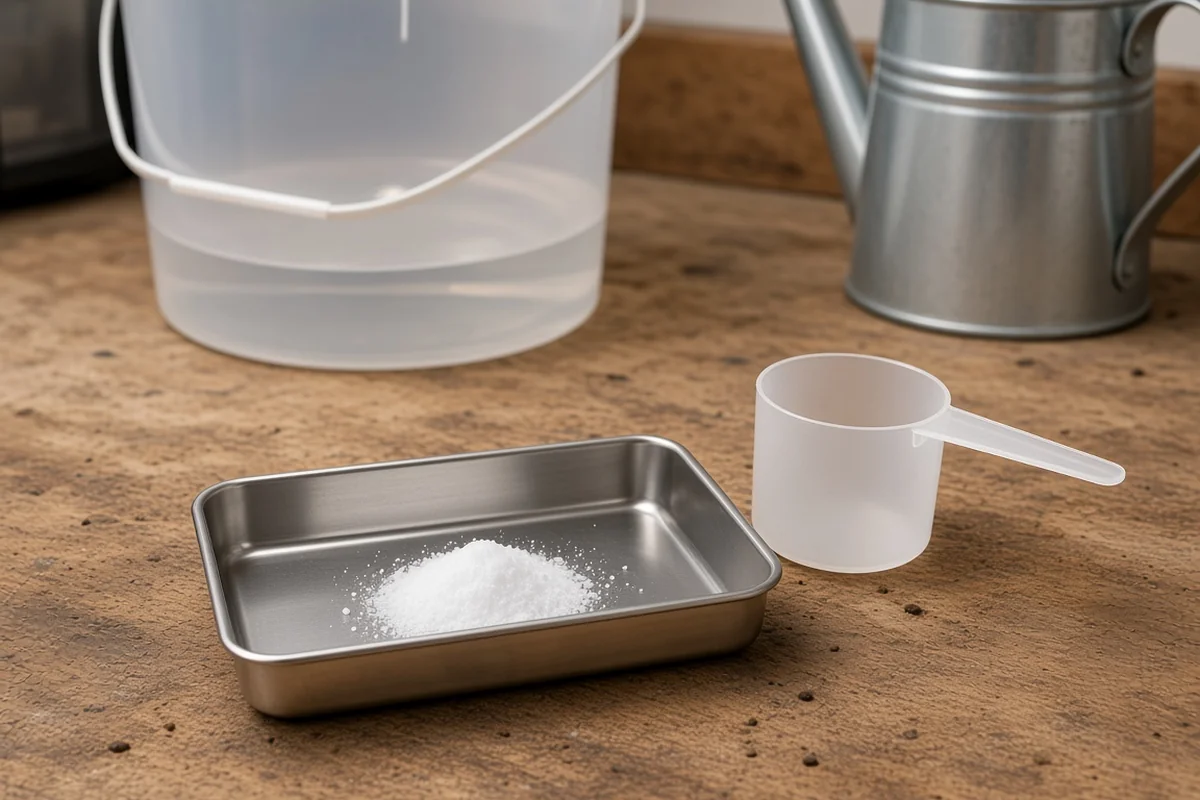
- Fill a clean bucket or watering can with the water volume for the current week (2 gallons for seedling and veg, 6 gallons for flower).
- Weigh each dose on a scale that reads to 0.01 oz. A Nutrient Dosing Kit ($37) includes a 0.1 g pocket scale, syringes, and two metric cups.
- Add one powder at a time and stir until it’s fully dissolved before adding the next.
- Check pH. Aim for 6.0 to 7.0 in soil (about 6 is a safe target) and 5.5 to 6.5 in hydro.
- In hydro, check EC. Kind Nutrients’ general guide is 1.0 to 2.5 for seedlings, 1.5 to 2.5 for veg, and 2.0 to 3.5 for bloom.
- Water thoroughly but don’t drown the plants. In soil, wait until the top inch feels dry before the next watering.
- Watch your plants for a few days and adjust strength based on what the leaves tell you.
For more detail on the weighing and dissolving part, read our guide on how to mix dry cannabis nutrients. If you water more than once a week, our post on how often to feed cannabis explains why feeding every other watering is a smart default.
Flushing in the Final Two Weeks
The Kind Nutrients product pages recommend flushing with plain water for about two weeks before harvest. Count back two weeks from the day you plan to cut, and from then on give the plants plain, pH-balanced water with no nutrients added. Independent trials are mixed on whether flushing changes the final product, and we cover that research in our flush before harvest guide.
Troubleshooting
Burnt leaf tips after the first veg feed. This usually means the dose went into too little water or the plant is small for its pot. Check that you used the full 2 gallons and skip the next feed, watering plain instead.
Pale lower leaves in veg. Yellowing older leaves often point to low nitrogen. Before adding more nutrients, check pH. Utah State University Extension notes that a soil pH above 7 can make phosphorus unavailable, and it ties iron problems to high-pH conditions along with cold, wet, or salty media, so an off pH can mimic shortages.
Dark, clawed leaves. Very dark green leaves that curl down at the tips signal too much nitrogen. Ease off and feed every other watering.
Brown leaf edges in flower. Kind Nutrients’ product notes say brown edges can point to low potassium. Confirm pH first, then make sure you’re mixing the full Flowertime dose.
Hydro EC creeping up. If runoff or reservoir EC climbs well above what you mixed, plants are drinking water faster than nutrients. Top up with plain pH-balanced water and ease off strength.
FAQ
Can I use this cannabis feeding schedule for autoflowers?
You can, with some adjustment. Autoflowers often move into flower on their own timeline, sometimes before week 7. Watch for pistils at the nodes and switch to Flowertime when you see them, even if the calendar says you’re still in veg, and keep a close eye on leaf tips. Don’t force the full veg block if the plant has already started flowering.
What if my veg lasts longer than four weeks?
Plenty of photoperiod growers veg for five or six weeks to fill a tent. The chart prints four veg weeks of Growtime, and the 0.88 oz pouch covers those four 0.21 oz doses with a little left over. If you extend veg, you’ll need more Growtime for the extra weeks. Keep the same dose per 2 gallons rather than stretching it thinner, and switch to the bloom feed once you flip your lights to 12 hours.
Do I need to feed every time I water?
No. Kind Nutrients’ guidance is that excess nutrients are harder to fix than deficiencies, so feeding every other watering is a smart default if you water more than once a week. In soil, plants often need water once or twice a week depending on pot size and temperature. Alternate feed and plain water. Pale growth means you can feed more consistently, while burnt tips mean back off.
Does the schedule work in hydro and coco?
Yes. The pouches are water-soluble and the product pages describe them as suitable for soil and hydro. In hydro you’ll mix doses into your reservoir and check EC as well as pH. Start on the lower end of the general EC guide. A hydroponic trial published in PMC (PMC11882401) found that doubling EC from 2 to 4 mS/cm built up salts without raising yield, so you rarely gain anything by pushing toward the top of the range.
Is the 6 Pack cheaper than buying the pouches separately?
Yes. The six single pouches add up to $156, and the 6 Pack sells for $138, so you save $18 and get every product the chart calls for in one order. Shipping is free on every US order with no minimum, and orders ship within 3 business days to all 50 states. Before you buy, know that all sales are final, so double-check your plant count and veg length first.
Sources
- Shiponi and Bernstein 2021, The Highs and Lows of P Supply in Medical Cannabis: Effects on Cannabinoids, the Ionome, and Morpho-Physiology, Frontiers in Plant Science
- Llewellyn et al. 2023, Foliar Symptomology, Nutrient Content, Yield, and Secondary Metabolite Variability of Cannabis Grown Hydroponically with Different Single-Element Nutrient Deficiencies, Plants
- Bevan et al. 2021, Optimisation of Nitrogen, Phosphorus, and Potassium for Soilless Production of Cannabis sativa in the Flowering Stage Using Response Surface Analysis, Frontiers in Plant Science
- Hershkowitz et al. 2025, Elevated root-zone P and nutrient concentration do not increase yield or cannabinoids in medical cannabis, Frontiers in Plant Science
- Utah State University Extension, Hemp Nutrient Deficiencies
Leave a Reply